Furnace repair · Spokane Valley ranches
Furnace repair for Spokane Valley ranches, closet to garage
Valley furnaces sit in hall closets and garage corners, pulling air through returns under the floor. Our van works the stretch between Argonne and Sullivan most days, with same-day windows for no-heat calls and one written price before work starts.
- Drive time
- About twenty minutes down I-90 from our Spokane shop.
- Typical furnace
- A 1990s replacement of the original 1970s unit in a ranch.
- Failure order
- Igniter, then flame sensor, then pressure switch and blower parts.
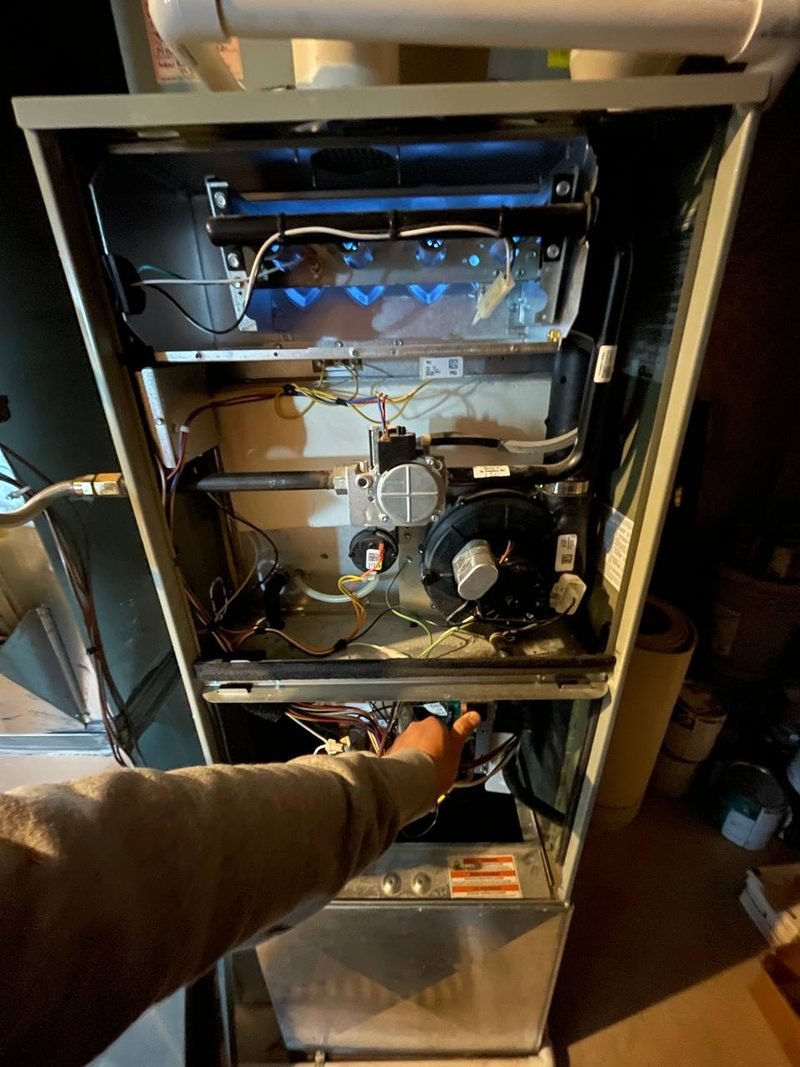
Valley houses are a generation younger than the ones in Spokane proper, and their furnaces have reached a predictable age. In Opportunity and Dishman the unit in the hall closet is often the 1990s replacement of a 1970s original, and it tends to fail in the same order every winter: igniters first, then flame sensors, pressure switches, and finally blower motors and boards. Newer houses east of Sullivan skip the igniter stage for a while and go straight to pressure switches and condensate traps. Knowing that order lets us stock the van for the Valley rather than for furnaces in general.
When yours stops, we walk its firing sequence with a meter and a manometer, read the flue with a combustion analyzer, and put one price in writing. The $99 diagnostic sits inside that price instead of on top of it, and if you decline the work it is the only charge. Same-day windows for no-heat run Monday through Saturday, and the Valley van is usually already somewhere between Argonne and Sullivan when your call comes in, so the twenty-minute run from our shop rarely applies.
Valley furnace faults, from hall closet to garage corner
| What you notice | What it usually is | What we do |
|---|---|---|
| Hums or clicks in the hall closet, never lights | Hot-surface igniter with a hairline crack, or a tired gas valve | Igniter resistance read on the meter, valve voltage tested, part swapped from the van |
| Flame for ten seconds, then lockout | Oxide on the flame sensor, or a pressure switch that will not hold | Sensor cleaned or replaced; manometer on the switch to check inducer draft |
| Garage furnace dies on the first single-digit night | Condensate line along an outside wall iced solid | Line thawed and rerouted, insulated or fitted with heat trace |
| Short bursts of heat all evening | Clogged filter on an under-floor return, or a failing limit switch | Filter and limit replaced; plain advice if the furnace is too big for the house |
| Nothing moves, not even the blower | Blower motor, run capacitor, board, or a tripped breaker | Capacitor and motor tested; breaker and circuit checked |
| Electric furnace south of Sprague barely warms | Heating element open or a sequencer stuck | Each element metered; failed parts replaced on the same visit |
What Valley furnaces run into, from Opportunity to east of Sullivan
A Spokane Valley ranch puts its furnace to work from October through April, usually in a hall closet or a corner of the attached garage, breathing whatever the return duct under the floor delivers. That return picks up a lot of dust in a busy single-story house, so the filter loads faster than owners expect, and a choked filter sits behind a good share of the short-cycling and limit-switch calls we take out here. Toward Chester and Ponderosa the utility spaces run colder, and condensate lines in that part of the Valley are the first to ice over when the overnight low drops into single digits.
A recent call shows the usual pattern. The furnace had clicked, the inducer had come up to speed, and nothing had lit; the owners heard it try three times and lock out. On the meter the igniter read far outside its resistance range, a crack too fine to see by eye, and the flame sensor behind it carried a winter’s worth of oxide. Both came off the van, the burners got a combustion check, and the house was warming before the paperwork was signed. Calls like that come from every corner of the Valley, which is why igniters, sensors and pressure switches for Bryant, Carrier, Ruud, Rheem, Amana, Goodman, Lennox, Trane and York stay stocked.
Older ranches south of Sprague still heat with electric furnaces more often than people assume. The elements, sequencers, relays and the circuit behind them are tested by one technician, who reads the amperage on each stage to show whether one element failed or several. When a gas furnace’s heat exchanger is in question, a camera goes in and you see the picture before any talk of replacement. For owners who would rather not meet the igniter problem at dawn, a fall tune-up starts from $129, and under our No-Breakdown Guarantee the tune-up price is credited against the repair if that furnace breaks down later the same season.
Typical Spokane Valley furnace repair prices
The repairs we write most often in the Valley are an igniter, starting at $175; a pressure switch, from $175; and a standard blower motor, which starts at $400. Those figures describe where such repairs begin for homeowners around Spokane, not what your furnace will need, and none of it is a quote. You get the real number in writing once the diagnostic is done, with the $99 already part of it, and an online booking takes up to $50 off the repair.
| Repair | Price |
|---|---|
| Furnace igniter | from $175 |
| Pressure switch | from $175 |
| Blower motor (standard PSC) | from $400 |
| Flame sensor cleaning or replacement | from $100 |
| Inducer motor | from $450 |
| Limit switch | from $150 |
| Furnace or air handler control board | from $350 |
| Gas valve | from $350 |
Starting prices in the Spokane area for 2026, part and work included. Not a quote: your exact price is in the written estimate after the $99 diagnostic.
Questions we hear
No heat in Spokane Valley tonight. Can someone come today?
Most days, yes. No-heat calls get same-day windows Monday through Saturday, and a van usually works the Valley between Argonne and Sullivan, twenty minutes from our shop. Calling in the morning leaves the most windows open. If we cannot fit you in, we say so rather than leave you waiting. In the meantime, check the furnace filter and make sure the switch on the side of the furnace is on.
Why does the filter matter so much in a Valley ranch?
Most single-story Valley ranches pull return air through a duct under the floor, and that air carries more dust than the furnace designers planned for. A loaded filter starves the furnace of airflow, the heat exchanger runs hot and the limit switch shuts the burners down, so the furnace cycles on and off. A clean filter cures some of these calls outright. When it does not, we test the limit switch and blower.
Do you repair electric furnaces in the older ranches south of Sprague?
Yes. Electric furnaces are common in that part of the Valley, and they fail on heating elements, sequencers and relays more than anything else. The breaker and the circuit feeding the furnace are tested by the same technician during the same visit, and the furnace repair comes with one written price.
Our condensate line ices up every January. Can that be fixed for good?
Usually. A line in a cold garage or along an outside wall is the weak spot, and it plugs with ice on the first single-digit night, which leaves the pressure switch open and the furnace idle. We thaw it, then move it inside the heated space, insulate it, or add heat trace where the route cannot change. It is a small repair that ends a yearly no-heat call.
Is a 1990s furnace in Opportunity or Dishman still worth repairing?
Most of the time. An igniter, flame sensor, pressure switch or capacitor on a sound furnace is a modest repair that buys years. If the heat exchanger is cracked, or the board and blower are both failing, you get a written repair figure and a written replacement figure side by side, plus the camera image if the exchanger is the issue. Stopping after the diagnostic costs only the $99.
Call, text or book
Tell us what the Valley furnace is doing by phone, text or the booking form; the form is the route that saves up to $50 on the repair. Whichever you choose, the $99 diagnostic is counted in the written price you approve.
Book a visit
Tell us what is going on
We call or text back to confirm a time window, usually the same day.
- $99 diagnostic Counted inside the written repair price you approve. Say no to the repair and it is the whole bill.
- Up to $50 off An HVAC repair booked online. Appliance repairs booked online: up to $22 off. Never taken off the diagnostic.
- Up to $500 off A full-system install booked through our site-visit form, first-year tune-up included. The site visit costs nothing.
Prefer to text? Send a photo of the model tag to (509) 370-5361.