Spokane Valley · ranges, stoves & ovens
Spokane Valley range and oven repair, Dishman to Greenacres
Valley kitchens run from 1970s coil ranges in Dishman to dual-fuel units in Greenacres, and each kind fails in a familiar way. We test the part before we name it, carry the usual suspects, and write the price before any work.
- Slow gas oven
- The Valley’s most frequent range call, usually fixed that visit.
- Coil to pro-style
- Original 1970s coil ranges through Wolf, Thermador and Viking.
- Supply tested
- Scorched receptacles and range circuits checked before any part is ordered.
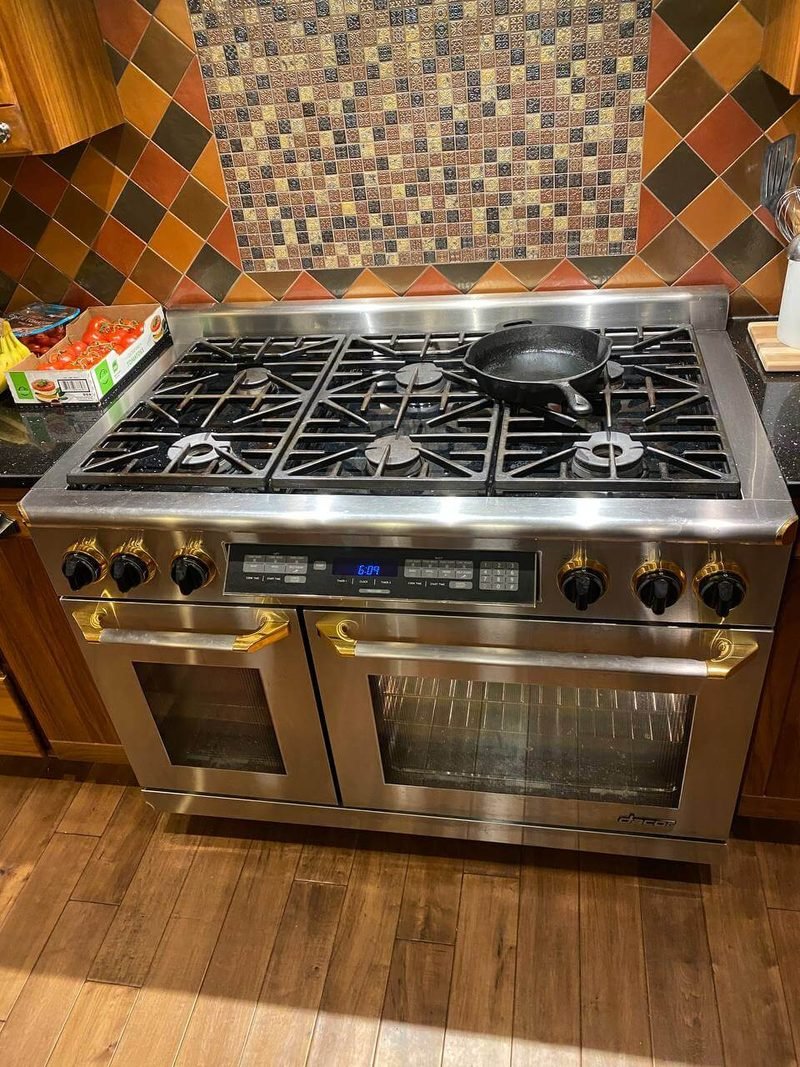
Most Valley range calls start with one of three sentences. The burner clicks and clicks but never lights. The oven says 350 and bakes like 300. The coil quit halfway through dinner. There is nothing mysterious in any of them. A range fails mechanically or electrically, and either way it leaves a trace: a hairline crack across an igniter, an element with no continuity, a sensor that disagrees with a probe in the cavity. Our technicians look for that trace before naming a part. The van carries igniters, elements, sensors, switches and spark modules for the Maytag, Kenmore, Whirlpool, GE, Frigidaire, LG and Samsung models that fill Valley kitchens, so most Spokane Valley range repairs are finished at the first visit.
Testing runs in a set order. For a clicking gas burner we look at the igniter first, then the burner ports, then the spark module. If the igniter is simply wet after a boil-over, it needs about ten minutes to dry out; if it is cracked, it gets replaced. A gas oven that lights slowly has its igniter measured while it is drawing current, because that number decides whether the valve can open at all. For an electric oven we read resistance across the bake and broil elements and check the sensor against a probe. A code on the display points us somewhere to look; it does not settle anything. Burner caps get reseated along the way, since a crooked cap lights unevenly. Each gas visit closes with a leak test at the regulator and every fitting. You then see one written number, and the $99 you paid for the testing is part of it, not on top of it.
Valley range symptoms and their usual causes
| What you notice | What it usually is | What we do |
|---|---|---|
| Burner clicks, no flame | Wet or split igniter, ports crusted over, or a spark module losing strength | Igniter left to dry or replaced, ports cleared, module swapped if weak |
| Oven igniter glows, gas never lights | Glow bar no longer drawing enough current to open the valve | New glow bar, valve current confirmed on the meter |
| Electric oven stays cold | Burned-open bake element, a sensor out of range, or a stuck relay | Element or sensor replaced; relay board only after it is proven |
| Baking 25 degrees off | Sensor drifted, or the control’s offset wandered | Sensor checked against a probe, then the offset reset |
| Convection fan rattles or stops | Fan motor bearings worn, or its circuit failed | Range pulled forward, fan replaced, anti-tip bracket refitted |
| One coil dead, the rest fine | That coil, a heat-damaged socket, or its control switch | Coil or switch replaced, receptacle swapped if it shows burning |
A day on the Valley range route
Our appliance van usually enters the Valley off I-90 at Argonne and works east along Sprague and Broadway toward Sullivan and Barker, and the kitchens get younger the farther out it goes. On the Dishman blocks and around the edge of Millwood, the typical range is an electric coil model from the 1970s or 80s, often the one the house came with, still turning out roasts on its second set of elements. In Opportunity and Veradale, remodels swapped in slide-in gas ranges and wall ovens. Past Sullivan and through the Greenacres subdivisions, you find glass cooktops, dual-fuel ranges and the professional-style names that came in builder upgrade packages. All of it sits comfortably inside our 35-minute radius.
Each of those generations has a signature failure. The coil ranges burn out an infinite switch or scorch a receptacle, and the fix is quick unless a loose coil has been jammed back into its socket for months. Gas kitchens south of Sprague go through oven igniters: the glow bar fades until it cannot pull the current the valve needs, and the room smells of gas before the oven finally catches. That slow-lighting oven is the range call we take most often anywhere in the Valley. Over in Greenacres, the newer electric ovens tend to lose a sensor or a relay board and report it with a code, which is the starting point for our testing, never the conclusion. If a coil wobbles in its socket, mention it when you call; the receptacle behind it usually needs attention too.
Valley ranches from the 1970s add two practical details. After several rounds of new flooring, the anti-tip bracket often sits too low to catch the range foot, so we reset it when the range goes back against the wall. And when an old receptacle has scorched, or a move from gas to electric calls for a circuit the original panel never expected, we test the supply and spell out in writing what the circuit needs. Wolf, Thermador, Viking, JennAir, Bosch and Miele parts come in after the first visit and are fitted on the return trip, again with no second trip fee.
Range and oven repair prices in the Valley
Because the slow-lighting gas oven leads our Valley call list, the igniter is the number most people ask about first: it starts at $175. A bake or broil element starts from $150, and a range control, swapped only once testing rules out the cheaper parts, from $250. Take those as starting prices drawn from Spokane-area jobs, not a quote; the figure that matters is written for your range after testing and already counts the $99. Recalibration comes with the repair at no added cost, there is no Saturday surcharge, and payment by card, cash or check happens when the range is working. An online booking brings up to $22 off the work.
| Repair | Price |
|---|---|
| Gas oven igniter | from $175 |
| Oven bake or broil element | from $150 |
| Range control board | from $250 |
| Surface element, switch or burner | from $125 |
| Oven temperature sensor | from $125 |
Starting prices in the Spokane area for 2026, part and work included. Not a quote: your exact price is in the written estimate after the $99 diagnostic.
Questions we hear
Is a thirty-year-old coil range in my Valley ranch worth repairing?
Most of the time. The design is simple, elements and switches for it are still manufactured, and a repaired one frequently outlives a lightweight new model. The exceptions are an oven liner rusted through or a wiring harness gone brittle; if either turns up, you hear about it before any work and can end the visit at the $99.
The kitchen smells of gas before my oven lights. What is going on?
A weakened igniter is letting gas into the cavity before it catches, so it should be repaired rather than lived with, and it is one of our most routine range jobs. Skip using the oven until the technician arrives. Any gas odor that lingers in the house means everyone out first, then a call to Avista or 911 from outside.
A burner started clicking after a pot boiled over. Does it need a part?
Maybe not. Water or sauce on a spark igniter makes it click without lighting until it dries, which can take ten minutes or so. If it keeps clicking once the cooktop is dry, the igniter may be cracked, the ports crusted, or the spark module weak. We test those in that order before quoting anything.
Do you work on pro-style ranges in the newer Valley kitchens?
Yes: Wolf, Thermador, Viking, JennAir, Bosch and Miele. Their parts almost never travel on a service van, so the first visit pins down the fault, we order the exact part, and the return trip installs it with no second trip fee. You approve the whole job in writing before anything is ordered.
My electric oven bakes cooler than the dial says. What usually causes that?
Most often the bake element has weakened or the oven sensor has drifted out of range. We read resistance across the bake and broil elements and check the sensor against a probe in the cavity, so the part we quote is the one that actually failed. Calibration settings on newer controls get checked along the way.
Call, text or book
Tell us by phone or text what the range is doing, or grab a Valley window online. The written repair price includes the $99 diagnostic, and Valley bookings made online take up to $22 off the work.
Book a visit
Tell us what is going on
We call or text back to confirm a time window, usually the same day.
- $99 diagnostic Counted inside the written repair price you approve. Say no to the repair and it is the whole bill.
- Up to $50 off An HVAC repair booked online. Appliance repairs booked online: up to $22 off. Never taken off the diagnostic.
- Up to $500 off A full-system install booked through our site-visit form, first-year tune-up included. The site visit costs nothing.
Prefer to text? Send a photo of the model tag to (509) 370-5361.