Spokane · cooling and heat pump service
AC and heat pump repair in Spokane, neighborhood by neighborhood
When the second week of July pushes the thermostat past 84, the systems that coasted through June start to fail. We test with gauges and a meter, write one price, and hold same-day windows for no-cool and no-heat calls, Monday through Saturday.
- Shop in town
- Our vans leave W Columbia Ave, a short drive from every Spokane neighborhood.
- Both refrigerant eras
- Old R-22 and new R-454B systems are serviced by our own technicians.
- Electrical tested
- Breakers, disconnects and supply voltage feeding the condenser are checked during diagnosis.
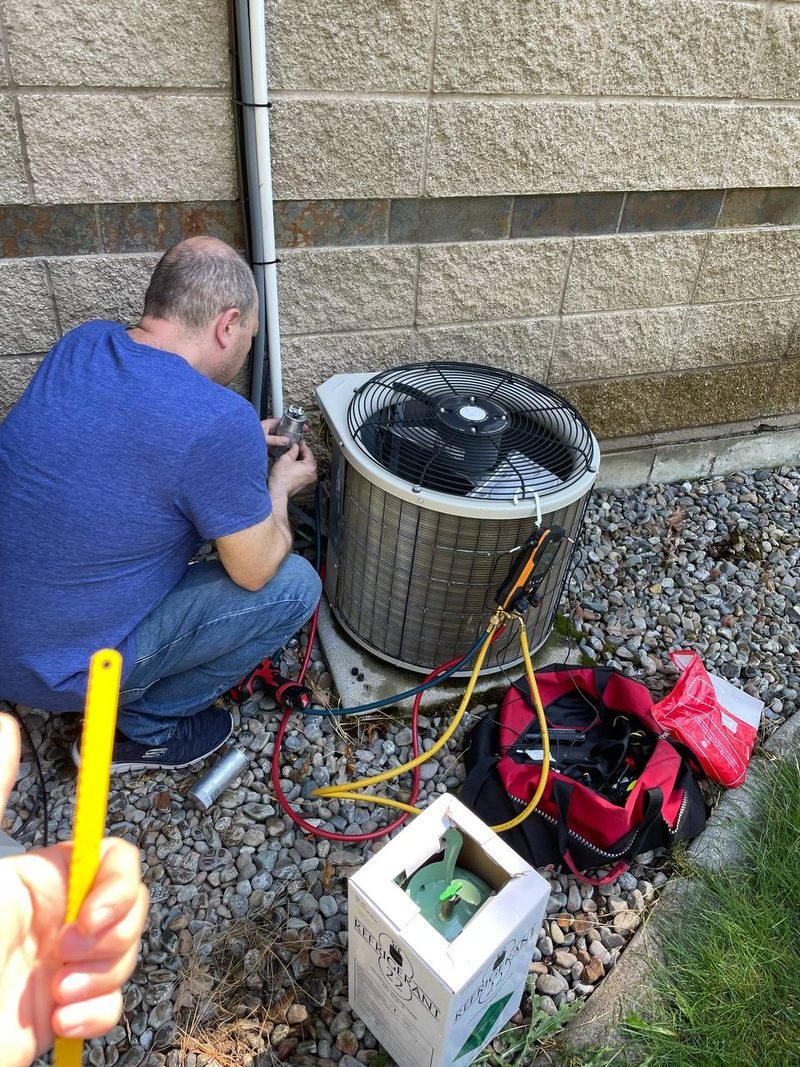
Spokane cooling is a short, intense season. A few weeks of dry 95°F afternoons arrive in July, and in many summers they are followed by wildfire smoke that keeps windows shut for days at a stretch. A system that idled through June suddenly runs twelve hours a day with no break, and whatever was marginal gives out: a run capacitor near the end of its rating, a slow leak, a filter nobody has looked at since spring. Heat pumps carry a second burden in February, when the outdoor coil has to defrost itself several times a day just to keep delivering heat to the house.
Our technicians do not price a repair from the symptom. Warm air at the registers has at least four common causes, each with a different bill, so the gauges and the meter come out before any number is written. Suction and head pressure, superheat and subcooling, capacitor microfarads and compressor amps tell us which one it is. You then receive a single written price with the $99 diagnostic tucked inside it. Say yes and that figure is the bill; say no and the $99 covers the visit with nothing added.
What a Spokane system tells you, and what we do about it
| What you notice | What it usually is | What we do |
|---|---|---|
| Warm air from the registers on a 95°F afternoon | Low charge from a leak, a dead run capacitor or contactor, or a worn-out compressor | Leak sealed before any recharge; capacitor or contactor swapped from van stock |
| Heat pump blowing cool air in February | Reversing valve stuck in cooling, a defrost board fault, or charge drifting low | Valve or board replaced, charge set by weight, defrost watched to completion |
| Frost creeping along the big copper line | Filter packed during smoke season, a dirty indoor coil, or a slowing blower | Filter changed, coil cleaned, blower tested; gauges confirm the charge |
| Outdoor unit hums while the fan blade sits still | Run capacitor, pitted contactor or a seized condenser fan motor | Part replaced on the visit; compressor amps read before and after |
| Cooling runs two or three minutes, then quits | Dirty coil, a pressure switch tripping, or a unit oversized for the house | Coil cleaned, switch replaced, sizing explained in plain terms |
| Breaker trips at startup in an older house | Hard-starting compressor, shorted motor, or a tired early-century circuit and disconnect | Compressor and circuit tested by one technician on one visit |
Where Spokane systems give out, from Shadle to the South Hill
The mid-century ranches in Shadle and Audubon-Downriver tend to have a 1990s condenser parked against a west wall, baking in the late sun; those are our first no-cool calls every July. On the South Hill and around Manito, craftsman houses picked up central air decades after they were built, often with an undersized coil sitting on a furnace that was never meant to push cold air up two floors. Up on Five Mile and along Indian Trail, newer homes run heat pumps whose failures show up in control boards and sensors rather than in capacitors.
Logan, Hillyard and the rest of the North Side still hold plenty of R-22 equipment, and the story there is usually a line set that rubbed against siding or a bracket for years until the charge fell below what the coil needs. The suction line frosts, the house warms, and the owner assumes the compressor is finished. Often it is not. A leak located with a detector, brazed, pulled into a deep vacuum and recharged by weight puts many of these systems back in service for several more summers, and we tell you plainly when it will not.
Then there is the electrical side. A lot of Spokane houses still run on panels from the 1920s through the 1950s, and an AC breaker added later can trip because the breaker itself is worn rather than the compressor. One technician checks the compressor windings, the disconnect and the breaker before naming the fault, and if the breaker is the problem you hear that before any part of the AC is replaced. Our vans start from the shop on the river’s north bank, a few blocks from Kendall Yards, so Audubon, Logan and the lower South Hill are minutes away and the far edges of the city are not much farther.
What AC and heat pump repairs run in Spokane
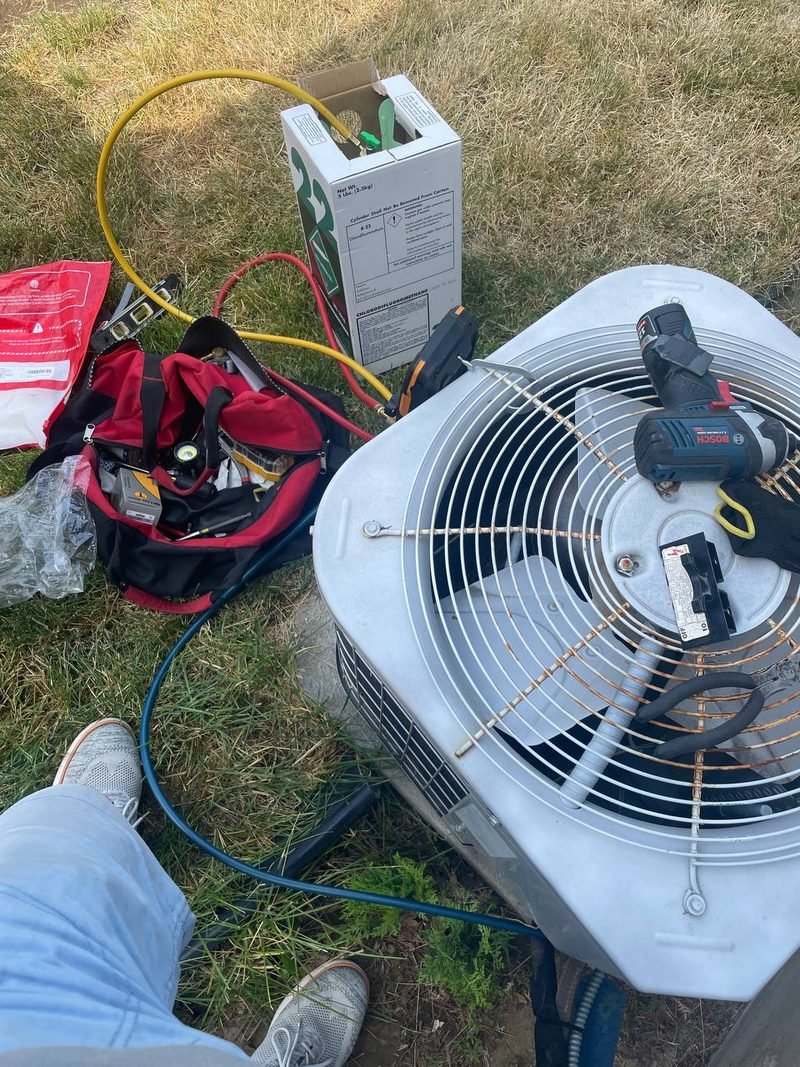
A run capacitor replacement starts at $150, and it is the most common July repair we make inside city limits. Finding and repairing a refrigerant leak, then recharging, starts at $400, with the final figure depending on where the leak sits and how much refrigerant the system holds. An outdoor fan motor starts at $350. All three are starting prices for the Spokane area, offered so you can plan; none is a quote. Your own price is set on paper once the diagnostic is finished, and the $99 is folded into it rather than billed on top. When a supplier part is needed, our return visit adds no second trip fee.
| Repair | Price |
|---|---|
| AC / heat pump capacitor | from $150 |
| Refrigerant leak repair and recharge | from $400 |
| Outdoor fan motor | from $350 |
| Contactor | from $175 |
| Heat pump defrost board | from $250 |
| Heat pump reversing valve | from $900 |
| Indoor (evaporator) coil | from $1,200 |
| Compressor (out of warranty) | from $1,800 |
Starting prices in the Spokane area for 2026, part and work included. Not a quote: your exact price is in the written estimate after the $99 diagnostic.
Questions we hear
The outdoor unit hums but the fan won’t turn. Is it the capacitor?
That is the likeliest cause, and it is a quick repair from van stock. Before the new capacitor goes in, the technician clamps an amp meter on the compressor, because a struggling compressor will kill a fresh capacitor within weeks. If the readings point at the compressor instead, you hear that first, in writing, before any money goes into a part that would not fix the problem.
Can you still repair an R-22 air conditioner?
Yes. Every technician on the crew has an EPA 608 Universal card, and a recovery machine rides in each van, so R-22 systems are recovered, repaired and recharged in-house, the same as R-410A, R-32 and R-454B equipment. R-22 itself is now scarce and costly, so on an older unit with a large leak we write the repair price, give you a plain opinion on whether replacement is the better use of that money, and leave the choice with you.
My AC trips the breaker in an old Spokane house. What should I do?
Resetting a tripped breaker one time is fine; a second trip means the circuit stays off until we look. The technician who measures the compressor also tests the breaker, the disconnect and the wiring running between them, and tells you whether the fault is in the AC or in the house. When the AC is at fault, we write one price and repair it on the same visit when the part is on the van.
My heat pump runs all day in February and the air feels lukewarm. Is it broken?
Not necessarily. Heat pump air leaves the registers cooler than furnace air, usually somewhere around 90 to 100°F, so lukewarm on its own can be normal. Cold air, or an outdoor coil that stays iced for hours, is a different matter: that points at the defrost board, the reversing valve or a low charge. Those calls get a same-day no-heat window, Monday through Saturday.
Does wildfire smoke affect my air conditioner?
Indirectly, yes. During smoke season the windows stay shut and the system runs far longer than in a normal July, and the filter loads with fine particles much faster. A packed filter starves the indoor coil of air, the coil ices, and cooling falls off. Check the filter every week or two while the smoke lasts. If the line is already frosted, switch cooling off at the thermostat, let it thaw, and call us.
Call, text or book
Warm air, a humming outdoor unit or ice on the line? Call or text us with what you see, ideally with a photo of the outdoor unit’s data plate, or use the booking form, which carries up to $50 off an HVAC repair booked online. Whatever repair you approve already has the $99 diagnostic inside its price.
Book a visit
Tell us what is going on
We call or text back to confirm a time window, usually the same day.
- $99 diagnostic Counted inside the written repair price you approve. Say no to the repair and it is the whole bill.
- Up to $50 off An HVAC repair booked online. Appliance repairs booked online: up to $22 off. Never taken off the diagnostic.
- Up to $500 off A full-system install booked through our site-visit form, first-year tune-up included. The site visit costs nothing.
Prefer to text? Send a photo of the model tag to (509) 370-5361.