Spokane Valley · refrigerator ice makers
Ice maker repair in Spokane Valley, where the cubes fade first
The cubes got smaller, then hollow, then stopped. In Spokane Valley that slow decline is usually hard water working on one small valve, though door-mounted ice makers in newer kitchens fail on optics, heaters and defrost instead.
- Fill measured
- Water caught and compared with what the mold should hold.
- Defrost tested
- A starved module is often the symptom, not the fault.
- Optics in sets
- Bin sensors on dispenser models replaced together.
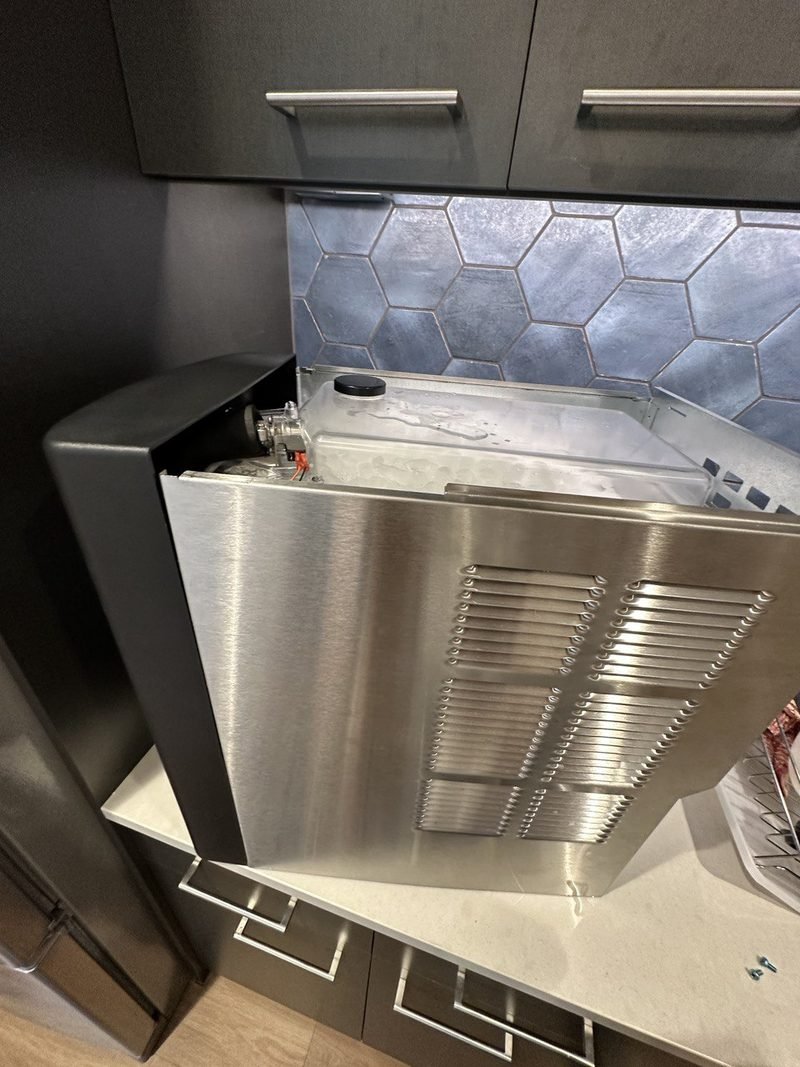
Ask a Valley homeowner when the ice maker died and you usually get a shrug, because it did not die so much as fade. Water from the aquifer beneath Spokane Valley carries enough calcium and magnesium to crust anything it heats or squeezes through a narrow opening, and the solenoid valve behind the refrigerator does both. Year by year that valve closes down until each fill brings less than the mold needs: smaller cubes first, then hollow shells, then a fill so slow it turns to ice inside the tube before it ever reaches the tray. It is the classic Valley case and the one our technicians open most often. Door-mounted ice makers in the newer kitchens follow a different script, which we cover further down.
We work from the water toward the ice. With the valve switched on for one normal cycle, the technician catches what comes out and checks it against the mold’s design volume. A short pour sends us to the valve, which gets an ohm reading on its coil, and to the filter, which gets its date read. The module goes next: mold heater, ejector motor and the thermostat that triggers a harvest all run through a forced cycle under observation. Dispenser models then have their bin optics and auger tested. Compartment temperature and the defrost cycle close out the visit, since no new module can make up for a refrigerator that cannot stay cold. What you approve is one written figure with the $99 diagnostic tucked inside.
Spokane Valley ice maker trouble, sorted
| What you notice | What it usually is | What we do |
|---|---|---|
| Bin empty, module silent | Iced fill tube, a dead inlet valve, or a failed module | Tube thawed and the cause found, valve or module replaced |
| Cubes smaller every week | Scaled valve or an overdue cartridge cutting the flow | Valve replaced, filter changed, fill volume measured |
| Ice smells or tastes off | Old filter, or odors drifting in from stored food | Filter replaced, bin and tray washed |
| One harvest a day, then nothing | Dirty or failed bin optics, or a control fault | Optics cleaned or replaced as a set, harvest cycle timed |
| Ice in the bin fused into a slab | Valve that will not close, cracked fill cup, tube out of line | Valve and fill cup replaced, tube reseated in its heater |
| Coil frosted over, no ice | Defrost heater or thermostat failure starving the module | Defrost part replaced first, module retested once cold returns |
District water, wells and the newer Valley kitchens
It makes no difference whether the house is an Opportunity or Veradale ranch on district water or a Ponderosa or Chester home with its own well; the hardness is the same. Winter brings a twist Valley owners recognize: a fill line that turns into a solid rod of ice every year. Either a worn valve keeps seeping after it should have closed and the seep hardens in the tube, or the tube has slid out of the heater sleeve meant to keep it clear. Thawing it only buys a week or so. The lasting fix is a new valve or a properly seated tube, with the mold heater tested while the back panel is off. Split fill cups and valves that seep after closing get replaced, not tinkered with.
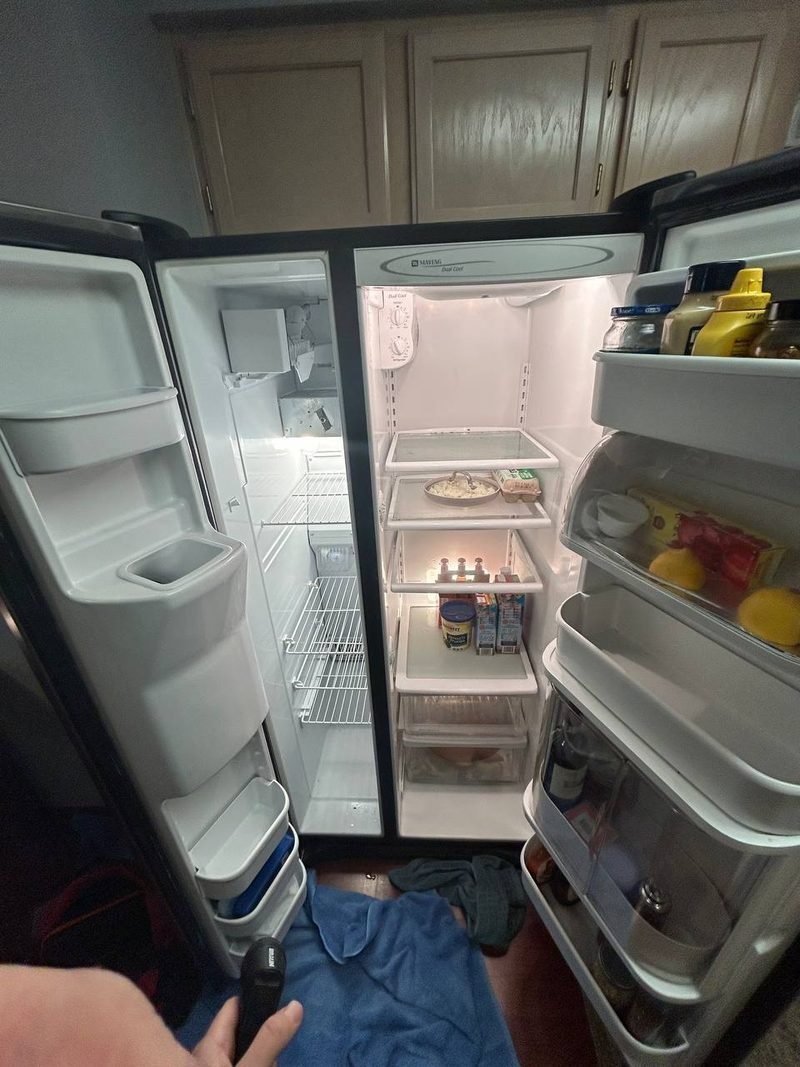
The rest of our Valley ice maker work comes from the newer kitchens east of Sullivan and around Greenacres. Many refrigerators there, French-door and side-by-side alike, put the ice maker up in the door or on the fresh-food side and keep it cold with a small evaporator of its own, a fan and a duct. Those layouts break down at the optics, the heaters and the control board more often than at the water valve, and they quit producing entirely once a defrost fault lets that little coil frost over. A Greenacres household recently reported a door dispenser producing just one harvest a day; dirty bin optics turned out to be the cause, the auger motor tested healthy, and the repair stayed with the optics. Door-mounted ice makers also depend on the seal around their compartment; a torn gasket there lets warm air in and frosts the chute.
Since every one of these ice makers is built into a refrigerator, the technicians doing the work are the same ones who handle sealed systems and refrigerant. Each carries EPA 608 Universal certification plus a recovery machine and gauges, so if the call uncovers a low charge or a weak compressor, it stays with us. The van carries inlet valves for Whirlpool, KitchenAid, GE, Frigidaire and LG along with standard modules and fill tubes; Maytag, Bosch and Kenmore are familiar territory too. Reaching the Valley is a straight run east on I-90 from the shop, comfortably within our 35-minute radius.
What Valley ice maker repairs usually run
Inlet valves are the part Valley ice makers go through most; a new one starts at $125. When a defrost fault has let the coil frost over, a defrost heater, thermostat or board runs from $175, and swapping in a whole ice maker assembly from $250. Read them as the point where rates around Spokane begin, not a promise for your refrigerator; the estimate we write after testing sets your number and already contains the $99. Should the module be past saving on a refrigerator that does not justify the money, we tell you so, and you owe nothing beyond the diagnostic. Waiting on an ordered part adds no second trip fee, you settle up by card, cash or check once ice is dropping again, and booking online trims up to $22 off the repair.
| Repair | Price |
|---|---|
| Ice maker fill valve | from $125 |
| Refrigerator defrost heater, thermostat or board | from $175 |
| Ice maker assembly | from $250 |
| Frozen fill line thawed and protected | from $125 |
| Refrigerator water inlet valve | from $125 |
Starting prices in the Spokane area for 2026, part and work included. Not a quote: your exact price is in the written estimate after the $99 diagnostic.
Questions we hear
My cubes get smaller every month. What is happening?
The mold is receiving less water each cycle, so the cubes shrink and eventually come out hollow, with the outside set and the center empty. Out here that nearly always traces to an inlet valve narrowed by scale or a cartridge long past its date. Both are routine, same-visit repairs, and a new valve is how most Valley ice maker calls end.
Should I put in a water softener or an inline filter for the ice maker?
For Valley water, a whole-house softener is the long-term fix, and the refrigerator’s own cartridge deserves more attention than it usually gets: once overdue, it throttles the fill just as surely as scale. We share what the fill measurement showed and what would help the next valve last.
Will a brand-new ice maker module fix hollow cubes?
Not on its own. A new module fed by the same scaled valve starves exactly like the old one did. Most silent or weak ice makers trace to the valve, the fill tube or the filter, so we prove the water side before replacing anything. The common modules are on the van for the cases where the module really has quit.
Do you repair the commercial ice machines in Valley restaurants?
Yes, through our commercial refrigeration service rather than this page. Under-counter and modular machines along Sprague, Pines and Sullivan get descaling, a same-day route if inventory is at risk of spoiling, and technicians with EPA 608 Universal certification for the refrigerant side. Here we focus on the ice maker inside a household refrigerator.
What if the refrigerator itself is running warm too?
Then the ice maker waits its turn. When the fresh-food side is warm, it goes on our same-day list, which runs Monday through Saturday, and the defrost or fan fault behind it is fixed first. Once the compartment is back down to temperature, the ice maker is retested, and you get one written price covering what was actually wrong.
Call, text or book
Call, text or book online and mention whether the cubes are shrinking, hollow or gone. Once you approve the repair, its price already covers the $99 diagnostic, and up to $22 comes off when you book online.
Book a visit
Tell us what is going on
We call or text back to confirm a time window, usually the same day.
- $99 diagnostic Counted inside the written repair price you approve. Say no to the repair and it is the whole bill.
- Up to $50 off An HVAC repair booked online. Appliance repairs booked online: up to $22 off. Never taken off the diagnostic.
- Up to $500 off A full-system install booked through our site-visit form, first-year tune-up included. The site visit costs nothing.
Prefer to text? Send a photo of the model tag to (509) 370-5361.