Furnace repair · Mead: gas, propane, electric
Mead furnace repair, whichever fuel the house burns
Mead heats three ways: natural gas in the neighborhoods around Farwell and Market Street, propane on the acreage, and electric furnaces where propane was never run. Each fuel fails differently, and the van carries parts for all three.
- Drive time
- Fifteen minutes up US-2, no surcharge for the far acreage.
- Propane twist
- Low tank pressure in a cold snap mimics a bad flame sensor.
- Dual fuel
- A furnace and heat pump fighting each other shows up on the bill.
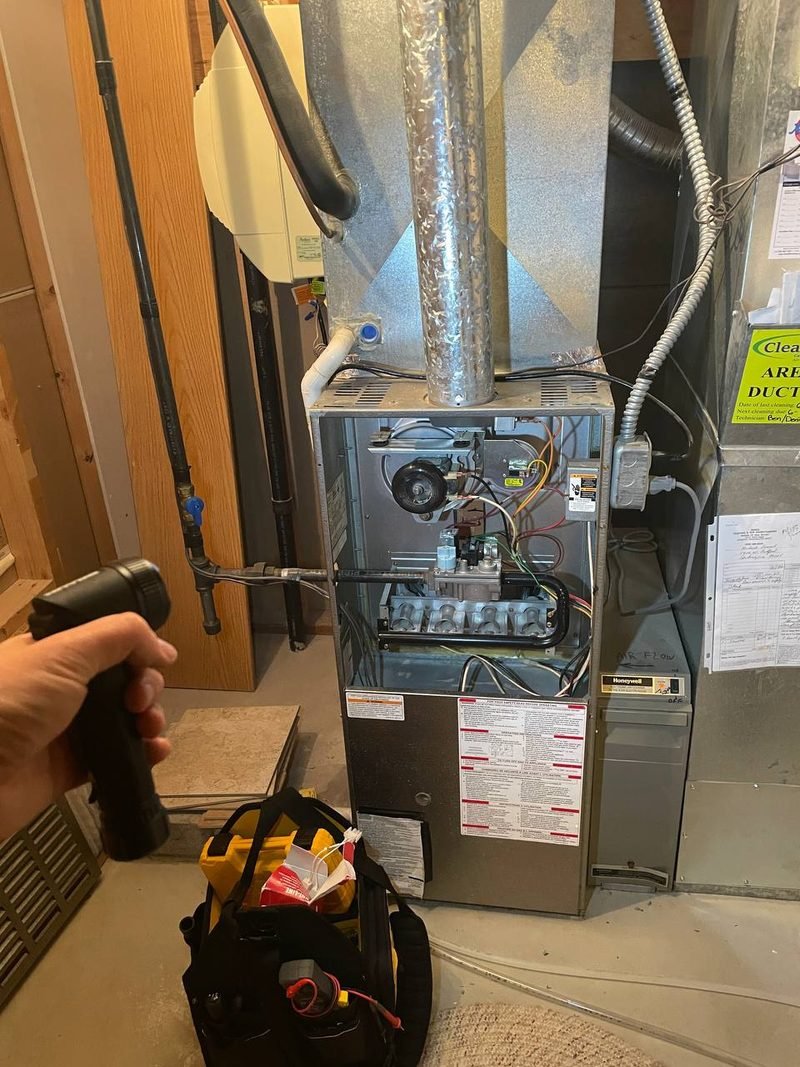
The Mead call usually comes after the third cold night. A propane furnace out past Peone Prairie has been lighting, running half a minute and shutting down with a flashing code, and the house has slipped into the fifties. Most of the time that pattern points to a flame sensor that can no longer prove the flame. On propane, though, there is a second suspect that city furnaces never face: a tank down to its last few percent during a cold snap, with the regulator struggling to hold pressure just as the furnace needs it most. Our technician checks both before naming either one.
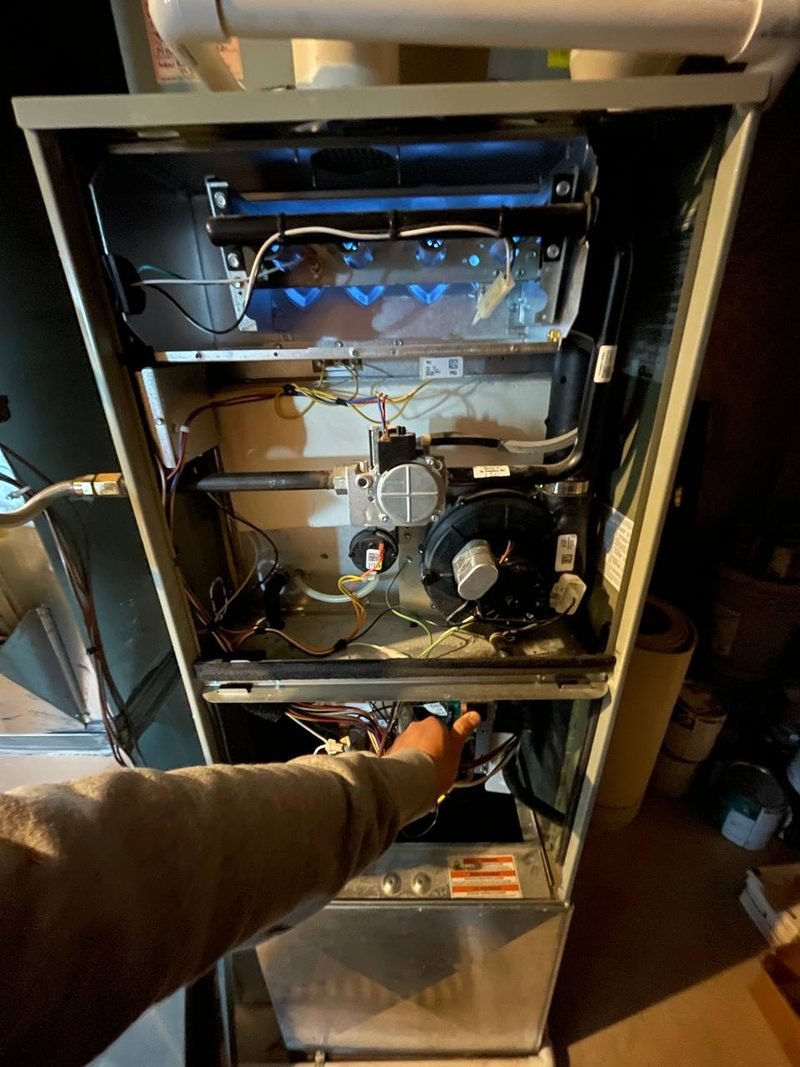
We repair propane, natural gas and electric furnaces throughout Mead, and no-heat calls are booked into same-day windows from Monday to Saturday. On every gas or propane unit the technician reads the flue with a combustion analyzer, which also reveals a burner running on the wrong orifice, and on propane the tank level and the pressure at the regulator get measured too. What you receive is one written price with the $99 diagnostic counted inside it, and every gas or propane repair closes with a leak check before the van pulls out of the driveway.
Mead furnace symptoms on gas, propane and electric
| What you notice | What it usually is | What we do |
|---|---|---|
| Lights, runs about thirty seconds, flashes a code | Coated flame sensor, or propane pressure sagging on a cold night | Sensor cleaned or replaced; regulator output and tank level checked |
| Inducer runs, igniter never glows | Igniter open on the meter, or no voltage reaching it from the board | Igniter swapped from van stock; board output confirmed |
| Yellow, lazy flame and soot on the burners | Burners never converted from natural gas to propane | Orifices corrected, burners cleaned, combustion analyzed |
| Furnace and heat pump both run, bill climbs | Dual-fuel controls set so the two systems fight | Changeover settings corrected and control wiring checked |
| Short cycling in a house near Farwell | Choked filter, a limit switch, or an oversized furnace | Filter and switch replaced; sizing explained plainly |
| Electric furnace on acreage, tepid air | Open element or failed sequencer | Elements and sequencers metered and replaced |
Three fuels in one town: what Mead furnaces need
The 1970s to 1990s neighborhoods around Farwell, Market Street and Mead High School are on natural gas, and their furnaces are second-generation units at the age where igniters and inducer motors give out. An inducer near the end of its life often announces itself with a rising whine or a rattle for a few weeks before the pressure switch stops closing, and that is the moment to call, before a cold morning makes the decision for you. Flame sensors in these houses also film over on schedule, and a fifteen-minute drive means the van is often at the door before the house has lost much heat. If the problem is a smell of gas rather than a cold house, leave and call Avista or 911 once you are outside.
The acreage toward Mt. Spokane is a different world. Larger homes there run propane from a tank in the yard, usually a bigger furnace paired with a heat pump, and the failures follow the fuel. Burners that were never properly converted from natural gas burn rich, soot the heat exchanger and shorten the furnace’s life. A tank running low on the coldest night drops supply pressure at the worst possible time. Condensate traps in unheated utility rooms and crawlspaces ice over. And on dual-fuel systems, controls set wrong let the furnace and heat pump fight each other, which shows up as short cycling and a large bill rather than a cold house. Our EPA 608 Universal certification means the heat pump in that equation is our work too.
Where propane was never run, the house heats with an electric furnace or with strips behind a heat pump. Those fail on sequencers and elements, which we replace, and the circuits feeding them are tested on the same visit. Many acreage properties also run a mini-split in a shop or outbuilding off the same rural panel, so when a furnace breaker trips we look at the whole load before blaming the furnace. The price card on Peone Prairie matches the one in Spokane, with no distance surcharge for the far properties, and a part that has to be ordered for an older propane furnace never brings a second trip fee.
Typical prices for Mead furnace repairs
Across Mead’s three fuels, the repairs we quote most are a flame sensor cleaning or replacement, from $100; a pressure switch, from $175; and an inducer motor on the older gas furnaces near Farwell, from $450. Consider those Spokane-area starting figures a guide only, never a quote. Your number is written once the diagnostic has found the fault, with the $99 inside it, and up to $50 comes off when the repair is booked online.
| Repair | Price |
|---|---|
| Flame sensor cleaning or replacement | from $100 |
| Pressure switch | from $175 |
| Inducer motor | from $450 |
| Furnace igniter | from $175 |
| Limit switch | from $150 |
| Furnace or air handler control board | from $350 |
| Gas valve | from $350 |
| Blower motor (standard PSC) | from $400 |
Starting prices in the Spokane area for 2026, part and work included. Not a quote: your exact price is in the written estimate after the $99 diagnostic.
Questions we hear
Is it the furnace or the propane tank when the heat quits on a cold night?
Sometimes both. A flame sensor coated in oxide causes the same short run and lockout as a tank that is nearly empty in a cold snap, when the regulator cannot hold pressure. Our technician meters the sensor, checks the tank level and measures pressure at the regulator and the gas valve, so you know which one to fix. If you ever smell gas, leave the house and call 911 from outside.
Why are the burners on our propane furnace yellow and sooty?
Usually because the furnace was never fully converted from natural gas. Propane needs different orifices and a different manifold pressure, and a unit left on natural gas parts burns rich, soots the burners and heat exchanger, and wears out early. We correct the orifices, set the pressure with a manometer, clean the burners and confirm the result with a combustion analyzer.
Our dual-fuel system short-cycles and the bill jumped. What is going on?
The controls that decide when the heat pump hands off to the furnace may be set wrong, so both run at once or the furnace fires far too often. We check the thermostat changeover, the outdoor sensor if there is one, and the wiring between the two systems. With EPA 608 Universal certification on our technicians’ cards, the heat pump side is part of the same visit.
Do you charge extra to reach acreage past Peone Prairie?
No. Mead is fifteen minutes up US-2 from our shop, and the far properties carry the same price card as a house in town, with no distance surcharge. No-heat calls get same-day windows Monday through Saturday. On a dual-fuel system, setting the thermostat to emergency heat lets the heat pump strips carry the house while you wait.
Do you repair electric furnaces on Mead acreage?
Yes. Homes that never had propane run often heat with an electric furnace or strips behind a heat pump. Sequencers, heating elements and contactors are tested and repaired by the same technician, the supply circuit is tested on that visit, and one written price covers the repair.
Call, text or book
Tell us the fuel and the symptom by call or text, or book online for up to $50 off the repair. The $99 diagnostic lives inside the written price you approve, and Mead is fifteen minutes from the shop.
Book a visit
Tell us what is going on
We call or text back to confirm a time window, usually the same day.
- $99 diagnostic Counted inside the written repair price you approve. Say no to the repair and it is the whole bill.
- Up to $50 off An HVAC repair booked online. Appliance repairs booked online: up to $22 off. Never taken off the diagnostic.
- Up to $500 off A full-system install booked through our site-visit form, first-year tune-up included. The site visit costs nothing.
Prefer to text? Send a photo of the model tag to (509) 370-5361.