A furnace that blows cold air is almost always a furnace that is not heating while its blower still runs. Either the thermostat is telling the fan to run on its own, or the furnace tried to light, a safety check failed, and the control shut the gas off. On our Spokane winter calls the cause usually comes from a short list, and you can check several of them yourself.
Safety first: If you smell gas, do not reset, relight or switch anything. Leave the house, then call the gas utility or 911 from outside. If a carbon monoxide alarm sounds, get everyone out into fresh air and call 911 from outside. Turn the furnace off at its power switch before you open any door on it, and never bypass, jump or tape a safety switch.
How a gas furnace lights, and why a failure feels like cold air
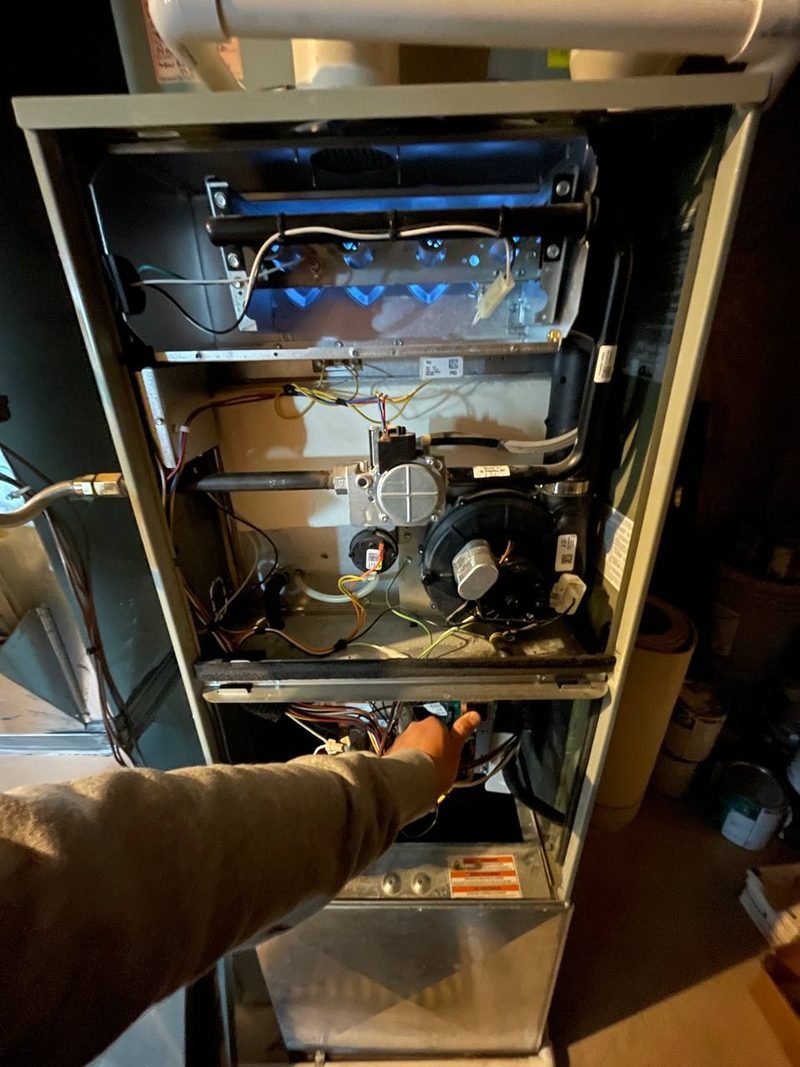
Every heating cycle follows the same order. The thermostat calls for heat. A small fan called the inducer motor pulls air through the burners and out the vent. A pressure switch confirms that draft. The igniter glows, the gas valve opens, and the burners light. A flame sensor proves the flame within a few seconds. After a short delay, the main blower starts and pushes warm air through the ducts.
If any step fails, the control board closes the gas valve and tries again. After a set number of failed tries, most boards lock out for a while. Meanwhile the blower may keep running, either to cool the heat exchanger or because the thermostat tells it to. That is the cold air you feel: room-temperature air, or colder air pulled through ducts in a crawlspace or garage, with no flame behind it.
The pattern you notice says a lot:
- Cold air nonstop, and the furnace never fires: a thermostat setting, power, or a lockout.
- The burners light, then go out within seconds: usually the flame sensor.
- The inducer hums but nothing lights: the pressure switch, a blocked vent or intake, a drain problem, or the igniter.
- Warm air for a few minutes, then cold, then warm again: the limit switch is tripping from poor airflow.
- Lukewarm air that never gets hot: on a dual-fuel system, the heat pump may be doing the heating.
Homeowner checks, in order
Work through these before you call. None of them needs tools.
- Thermostat mode and fan setting. Make sure the thermostat is on HEAT and set a few degrees above room temperature. Then look at the fan setting. On ON, the blower runs all the time, including between heating cycles, so the registers blow unheated air whenever the burners are off. That air feels cold against your hand, especially where ducts run through an unheated space. Set the fan to AUTO and see whether the cold air stops between cycles. Replace weak batteries, and check that a schedule or away mode is not holding the temperature down.
- Power to the furnace. The furnace power switch looks like a light switch, on the furnace or on a wall or joist nearby. Make sure it is on. Check whether the furnace breaker has tripped and reset it once; if it trips again, leave it off and call us. Also check that the lower furnace door is pushed fully into place. A safety switch behind it keeps the furnace off when the door is loose.
- The filter. Turn the furnace off, slide the filter out and hold it up to a light. If you cannot see light through it, replace it, with the airflow arrow pointing toward the furnace. A clogged filter starves the furnace of air and trips the limit switch, one of the most common causes of cold-air cycling. In Spokane, a filter that sat through a summer of wildfire smoke is often loaded by the first cold snap. Also open closed registers and move furniture off return grilles.
- The vent and intake pipes outside. High-efficiency furnaces vent through two white plastic pipes, out a side wall or up through the roof. One brings in combustion air and the other carries out exhaust. After heavy snow, drifting, or days of freezing fog during a winter inversion, those pipe ends can be buried or crusted over, and the furnace will refuse to light. Many newer homes in Spokane Valley, Liberty Lake and the West Plains have these pipes on a side wall where drifts pile up. Brush snow away with a gloved hand or a soft broom and keep the area clear all winter. Do not push anything into the pipes. If there is ice inside a pipe, leave it and call us.
- Water around the furnace. A high-efficiency furnace makes water as it burns gas, and that water runs through a trap and a hose to a floor drain or a small condensate pump. Look for water on the floor, a gurgling sound, or a condensate pump that is full or unplugged. Make sure the drain hose is not kinked, and if the drain line runs outdoors or through a cold garage, check whether it has frozen. Leave the trap itself alone: it sits close to the control board and pressure switch, and a spill there can damage both.
- Read the blinking light. See the next section. Do this before you take any door off.
- One reset. After you fix something, such as the filter or a buried vent, turn the furnace off at its switch, wait a minute, and turn it back on. Listen through one full start-up. If it lights and keeps running, you found it. If it fails the same way again, stop resetting and call. Repeated resets do not fix a failing part, and they can clear the fault we would read.
How to read the furnace LED code
Most modern furnaces have a small light on the control board that blinks a pattern to report what went wrong. You can usually see it through a small window, sometimes called a sight glass, in the lower blower door. Read it before you remove that door: taking the door off opens the door switch, cuts power to the board, and on many furnaces clears the fault.
- Use a flashlight, or take a short phone video, and watch at least two full rounds of the pattern.
- Count the flashes between the long pauses and write it down plainly, for example: three short flashes, pause, repeat. Note any second color, or fast and slow flashing.
- The chart that explains the codes is usually on a label on the door. If you must remove the door to see it, record the blinking first.
Codes differ from brand to brand, so go by your own furnace's chart. A steady light or a slow, even heartbeat blink usually means normal operation. A code tells us where to start, not always which part failed: a pressure switch code can come from a bad switch, a blocked vent, a backed-up drain or a weak inducer.
What usually fails inside, and why
These parts sit in the burner compartment, next to the gas valve and line-voltage wiring, so this is technician work.
Flame sensor
The flame sensor is a thin metal rod that sits in the burner flame. The control board sends a tiny electrical signal through the flame to the rod to prove the burners are lit. Over time a film builds up on the rod from combustion, the signal weakens, the board can no longer prove flame, and it shuts the gas valve within seconds. You hear the burners light, go out, and try again. We clean or replace it and check its ground, porcelain and flame contact, because a sensor that fouls fast usually has a reason.
Igniter
Most furnaces use a hot surface igniter, a small ceramic element that glows bright orange. It is brittle, and years of heating up and cooling down make it crack. A cracked igniter may glow faintly or not at all, so the gas never lights. The inducer runs, nothing ignites, and the furnace retries and locks out. Do not touch one: they snap easily, and skin oils shorten the life of many types.
Pressure switch and inducer
The inducer motor pulls combustion gases out through the vent. The pressure switch, a small round switch connected by a rubber hose, only closes when the inducer creates enough suction. That is a safety: if the vent is blocked, the burners never light, so exhaust cannot spill into the house. The switch stays open because of snow over the vent or intake, water backed up from a clogged trap or frozen drain line, a cracked or loose hose, an inducer with worn bearings that spins too slowly, or a failed switch. Each has a different fix, which is why we test instead of simply swapping the switch.
Limit switch trips from poor airflow
The high limit switch watches the temperature around the heat exchanger. When too little air moves across it, because of a clogged filter, closed registers, a dirty blower wheel, a weak blower motor or capacitor, or a dirty air conditioner coil on top of the furnace, the heat exchanger overheats. The limit opens and the burners shut off, but the blower keeps running to cool things down. That is the cold air. Once it cools, the furnace lights again and the cycle repeats. Repeated overheating is hard on the heat exchanger, and many controls lock out after several trips in a row. Some furnaces also have a small rollout switch near the burners with a reset button. If you find one tripped, do not reset it: flame came out of the burner area where it should not be, and that needs a technician.
When a heat pump is part of the system
If your home pairs a gas furnace with a heat pump, often called dual fuel, the heat pump handles milder weather and the furnace takes over in a cold snap or when the heat pump cannot keep up. Heat pump air is warm but feels cooler against your hand than furnace air. That lukewarm air is normal.
Two situations do point to a problem. During a defrost cycle the heat pump briefly runs in reverse, and the furnace should fire at the same time to warm the air. If you get a few minutes of chilly air while the outdoor unit steams, the furnace may not be coming on during defrost, or a control setting is off. And if it is bitterly cold outside and you still get only lukewarm air, the system may not be switching over to the furnace.
A quick test: set the thermostat to AUX or EM heat. On a dual-fuel system that shuts the heat pump off and runs the furnace alone. If the house warms up, the furnace is working and the problem is on the heat pump side or in the controls between the two. If the air stays cold, the furnace is the problem.
What to tell the office when you call
- Model and serial number from the rating label, usually inside the front door or on the side of the cabinet. Read the LED first, then switch the furnace off before you take a door off. A phone photo of the label is perfect.
- The LED code and how you counted it, or the video.
- The symptom: cold air nonstop, warm then cold, or lights and goes out, plus any sounds such as clicking, humming or squealing.
- When it started and what happened just before: a snowstorm, a power outage, a filter change.
- The type of furnace: white plastic vent pipes, or a metal flue into a chimney, as on many basement furnaces in older South Hill and North Side homes.
- Whether you have a heat pump, and what happened on AUX or EM heat.
- What you already tried: new filter, pipes cleared, breaker reset once.
If you ask about cost, the office names the diagnostic fee when you call, and the technician writes one price before any work starts. You can read more about our furnace repair in Spokane.
Keeping it from happening again
Most cold-air causes build up slowly: film on the flame sensor, sludge in the trap, a dirty blower wheel, an aging igniter. On a fall maintenance visit we clean the flame sensor, check the igniter, flush the condensate trap, test the pressure switch and limits, check gas pressure and temperature rise, and look over the vent pipes. Between visits, change the filter through the heating season and clear the outdoor pipes after every snow.
When to call us
- The furnace still blows cold air after you have checked the thermostat, power, filter and outdoor pipes.
- It lights and goes out, or tries to light and shuts down, again after one reset.
- The LED shows a fault code, or there is ice inside a vent pipe.
- There is water around the furnace or the condensate pump keeps filling.
- The breaker trips a second time, or a rollout switch has tripped.
- On a dual-fuel system, the house stays cold even on AUX or EM heat.
We answer calls every day; call and the office tells you whether a technician can reach your address today. You can also call or text (509) 370-5361 with your model number and the blink pattern.
Page reviewed by Adam, Larch technician
Technician · heating, cooling and appliances · Updated October 2026
Adam works on furnaces, heat pumps, AC and household appliances on our Spokane-area calls. He tests first, shows you the failed part and writes the price before any repair.