Safety first: Unplug the dryer before you pull it out, disconnect the duct or clean anything inside the door opening. Lint burns easily, so stop using a dryer that smells hot or scorched, and do not leave one running when no one is home. If you have a gas dryer and smell gas, do not touch switches or plugs: leave the house, then call the gas utility or 911 from outside.
Electric or gas: know which dryer you have
A dryer that tumbles without heat has one basic problem: the drum motor has power, but the heat source is not turning on or is shutting off early. Where to look depends on how your dryer makes heat.
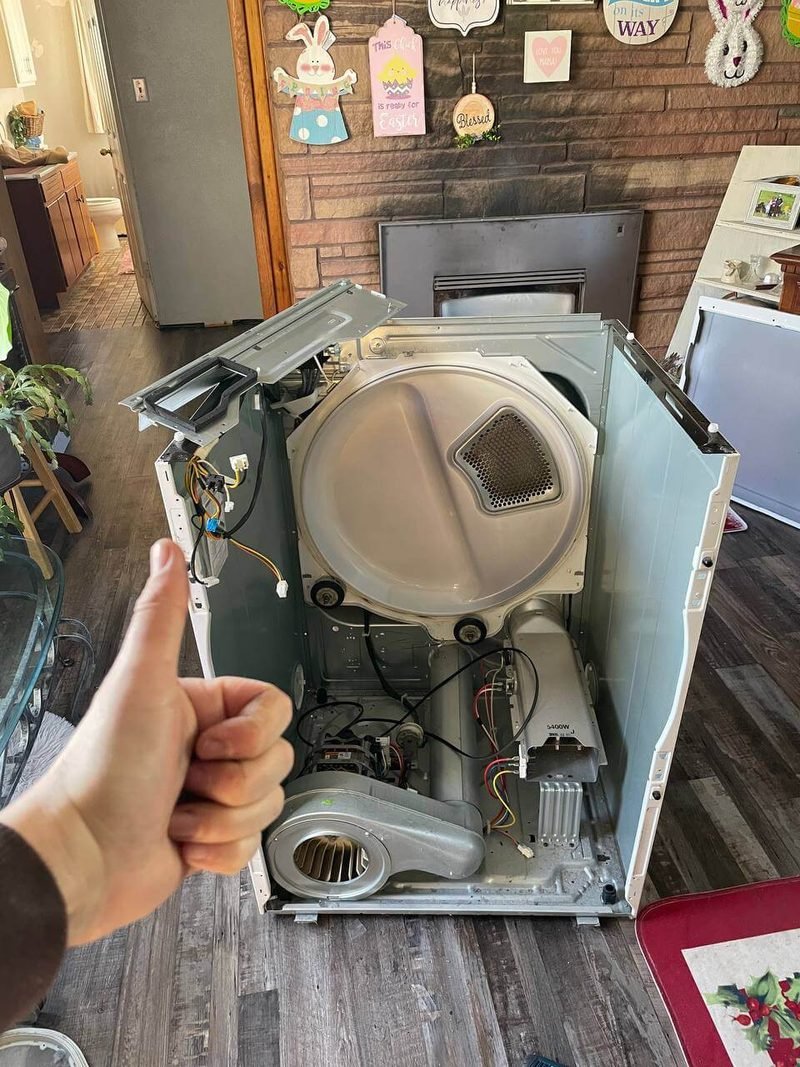
An electric dryer has a large three- or four-prong plug and no gas pipe behind it. It runs on 240 volts and heats with a coil of resistance wire called the heating element. A gas dryer has an ordinary household plug plus a gas line with a shutoff valve and a flexible connector at the back. It heats with a burner lit by a glowing igniter. Both share the same drum, blower, lint screen, vent and heat safety parts.
On our calls we see the same pattern in both types: the dryer that "won't heat" and the dryer that "takes two or three cycles" are often one problem at different stages. Poor airflow makes the dryer slow first, then trips a safety part that stops the heat altogether.
Electric dryers need two legs of power
An electric dryer is fed by a double breaker: two breakers joined by one handle, each supplying one 120-volt leg. On most electric dryers the motor, lights and controls run on a single leg, while the heating element needs both legs together to make 240 volts. If one half of that breaker trips, the dryer still starts, the drum turns and the display lights up, but the element gets nothing.
A tripped breaker does not always flip all the way over. It often sits in a middle position that looks almost on. You may check it and reset it once: turn the dryer off at its controls, find the double breaker labeled for the dryer in your breaker box, push the handle firmly to off, then back to on, and run a timed high-heat cycle for a few minutes.
That single reset is the whole homeowner job here. If it trips again, leave it off and call us. A breaker that trips under a dryer load often points to a heating element that has sagged against its metal housing, or a scorched connection at the dryer's terminal block or cord, and those need a technician with a meter, not a second reset.
Homeowner checks, in order
None of these require opening the cabinet.
- Check the cycle. Air-only, fluff, wrinkle-release and some delicate or eco settings use little or no heat. Run a timed dry on high heat with damp towels so you are testing the heat, not the sensor.
- Check the power or gas supply. On an electric dryer, check the double breaker once, as above. On a gas dryer, look at the shutoff valve on the gas line behind the dryer: the handle should line up with the pipe. If your gas furnace or gas range works, gas is reaching the house. Do not loosen fittings or bend the flexible connector.
- Clean and wash the lint screen. Pull lint off before every load. Then run water over the clean screen. If water pools instead of running through, a film from dryer sheets or softener is blocking it. Scrub it with warm soapy water and a soft brush, rinse it and let it dry.
- Clean the moisture sensor bars. Dryers with sensor or auto-dry cycles have two metal strips inside the door opening, usually near the lint screen. With the dryer unplugged, wipe them with a soft cloth and a little rubbing alcohol.
- Feel the airflow outside. Start the dryer on high heat and go to the vent cap. On a wall cap, the flap should open fully and you should feel a strong, warm stream. A flap that barely lifts means the duct is restricted.
- Look behind the dryer. Unplug it and pull it out gently. Move a gas dryer only as far as the gas connector allows. Look for a duct that is crushed, kinked or pinched against the wall, and for lint packed in the first few feet.
- Look at the load and the washer. An oversized load tumbles in a lump and dries slowly. If clothes come out of the washer dripping instead of damp, the washer is not spinning the water out, and no dryer will keep up. That is a washer repair question, not a dryer one.
The vent run: where Spokane dryers lose airflow
The lint screen catches most lint, not all of it. The rest settles in the duct, and as the duct narrows the dryer moves less air. Moist air stays in the drum longer, so loads take longer. Heat also stays in the heater box, right where the safety parts sit.
Older homes: long basement runs
In older South Hill and North Side homes, the laundry often sits in a basement far from an outside wall. The duct runs along the ceiling joists and turns several corners before it reaches the rim joist. Every elbow and every foot adds resistance, lint settles in long horizontal stretches and low spots, and older joints fastened with screws snag lint in the airstream.
Newer homes: stacked units and tight closets
In newer homes in Spokane Valley, Liberty Lake and the West Plains, laundry is often upstairs or in a closet, sometimes as a stacked washer and dryer. The dryer gets pushed tight to the wall and the soft foil duct behind it crushes flat where nobody can see it. These homes often vent through the roof or a high wall, so air has to travel up as well as out, and a roof cap is easy to forget.
Caps, screens and nests
Wall cap flaps stick, get painted over or pack with lint. Roof caps catch lint under the hood, and a cap with a screen meant for a bath fan will trap lint until it seals. Birds nest in wall caps in spring, especially when a flap is broken. In a winter cold snap, moisture in the exhaust can frost a flap partly shut, and a low wall cap can disappear under drifted or plowed snow.
A crushed foil duct should be replaced with a short semi-rigid or rigid metal duct with as few bends as the space allows. Plastic or vinyl duct does not belong on a dryer.
What a vent airflow test is
A vent airflow test measures what the dryer is actually moving instead of guessing from the lint you can see. The technician runs the dryer and uses instruments to measure air speed at the outlet and the back pressure in the duct, once with the duct connected and once at the dryer itself. We also check exhaust temperature and how the heat cycles.
The comparison shows where the restriction is. Strong flow at the dryer and weak flow outside means the duct is the problem. Weak flow at the dryer points inside: a lint-packed blower wheel or lint built up in the housing. That matters, because replacing a fuse or thermostat without fixing airflow sets up the next failure.
You can do a rough version without heat. With the dryer unplugged, disconnect the duct at the back, plug it back in and run an air-only setting for a minute while you feel the outlet. Then reconnect it and feel the outside cap. A big drop between the two means the duct needs cleaning or a better route.
The parts that stop the heat, and why they fail
Once supply and airflow check out, the cause is usually a part in the heat circuit. These sit next to live terminals, sharp sheet metal and, on gas models, the gas valve, so this is technician work with the dryer unplugged.
Thermal fuse
The thermal fuse is a small one-time safety part, usually on the blower housing or exhaust duct inside the cabinet. If the air there gets too hot, it opens and stays open. On some dryers that stops the motor; on many others it cuts only the heat, so the drum tumbles cold. A fuse rarely fails on its own. It blows because the dryer overheated, and the usual reason is restricted airflow. Never bridge a blown fuse with a wire to get heat back: that removes the part that helps stop a lint fire. When we replace a fuse, we look for the reason it blew.
Cycling and high-limit thermostats
The cycling thermostat, or on many newer dryers a temperature sensor read by the control, switches the heat off and on to hold the temperature you chose. The high-limit thermostat sits on the heater housing or burner tube and opens if that area overheats. With a restricted vent, the high-limit keeps opening, the heat is off much of the cycle, and a load takes two or three runs. A cycling thermostat stuck open gives no heat; one stuck closed lets the dryer overheat until the high-limit or fuse steps in.
Heating element (electric)
The element is a coil of resistance wire in a metal housing or strung on ceramic insulators. Years of heating and cooling make the wire brittle, and poor airflow creates hot spots where it burns through. A broken coil gives cold air with everything else normal. A coil that sags and touches the housing can trip the breaker. Some dryers use two coils, and losing one leaves the dryer warm but slow. Many dryers also route the heat through a switch on the drive motor that closes only when the motor is up to speed, so a worn motor switch can look like a bad element.
Igniter and gas valve coils (gas)
When a gas dryer calls for heat, the igniter, a small glow bar, heats until it glows bright orange. A flame sensor on the burner tube detects that heat and switches power to the gas valve coils, which open the valve. Gas flows and lights on the hot igniter. Igniters are brittle and crack with age. The valve coils weaken over time and often fail once warm, which gives a familiar pattern: the first load heats, later loads don't, and a technician watching the burner sees the igniter glow, go dark and no flame follow. If the igniter never glows, the cause is the igniter, the flame sensor or a safety part ahead of them.
Moisture sensor and auto-dry settings
Auto-dry cycles end when the control decides the clothes are dry. Wet clothes brushing the sensor bars conduct a little electricity; dry clothes don't. Film on the bars makes wet clothes read as dry, so the cycle ends early and you run it again. If a timed high-heat cycle dries a load but auto-dry leaves it damp, the heat is fine and the sensor or the dryness setting is the issue. If your dryer shows a vent or airflow warning, treat it as a real reading.
Lint fires and other warning signs
Lint is fine, dry fiber and lights easily. A clogged vent makes the cabinet run hotter, and lint that gets past the screen collects around the drum, heater box and blower. Stop using the dryer and unplug it if you notice a burning smell, a cabinet top too hot to rest your hand on, clothes that come out hot rather than warm, or lint around the outside cap. Don't run it when you leave the house or go to bed. If you see smoke or flame, get everyone out and call 911.
A blocked vent on a gas dryer can also push combustion gases back into the house, so keep a working carbon monoxide alarm near the laundry and the bedrooms.
What to tell the office when you call
- Brand and model number, from the label inside the door opening or on the back.
- Electric or gas.
- The symptom: no heat at all, some heat but slow, heats the first load only, or stops mid-cycle.
- When it started and anything around then: a move, a breaker trip, a vent cleaning, a power outage.
- How it vents: wall or roof, roughly how far, and whether it is stacked or in a closet.
- What you already checked, including the breaker reset and the airflow at the outside cap.
If cost comes up, the office names the diagnostic fee when you call, and the technician writes one price before any work starts. Our pricing page explains how that works.
When to call us
Call us if the breaker trips again after one reset, if a gas dryer's igniter glows but no flame lights, if there is still no heat after the lint screen and vent check out, if a load still needs more than one timed high-heat cycle, or if you have noticed a burning smell. Our dryer repair technicians work on electric and gas dryers across Spokane, Spokane Valley and nearby towns.
We answer calls every day; call and the office tells you whether a technician can reach your address today. You can also call or text (509) 370-5361.

Page reviewed by Adam, Larch technician
Technician · heating, cooling and appliances · Updated October 2026
Adam works on furnaces, heat pumps, AC and household appliances on our Spokane-area calls. He tests first, shows you the failed part and writes the price before any repair.