Safety first: Unplug the refrigerator before you clean the condenser coils, remove a grille or reach near a fan. Never chip ice with knives, screwdrivers or ice picks, and never aim a heat gun at the freezer: the evaporator coil is part of the sealed refrigerant system, and a punctured coil is not a simple repair. Never open or try to recharge the sealed system.
How cold air reaches the fresh-food side
Most household refrigerators with automatic defrost make all of their cold in one place: an evaporator coil hidden behind a panel in the freezer. Refrigerant boils inside that coil and pulls heat out of the air around it. An evaporator fan pulls air across the coil and blows it into the freezer. Part of that cold air is sent through a duct into the fresh-food section, and a damper controls how much. Air from the fresh-food side returns to the coil through a second passage to be cooled again.
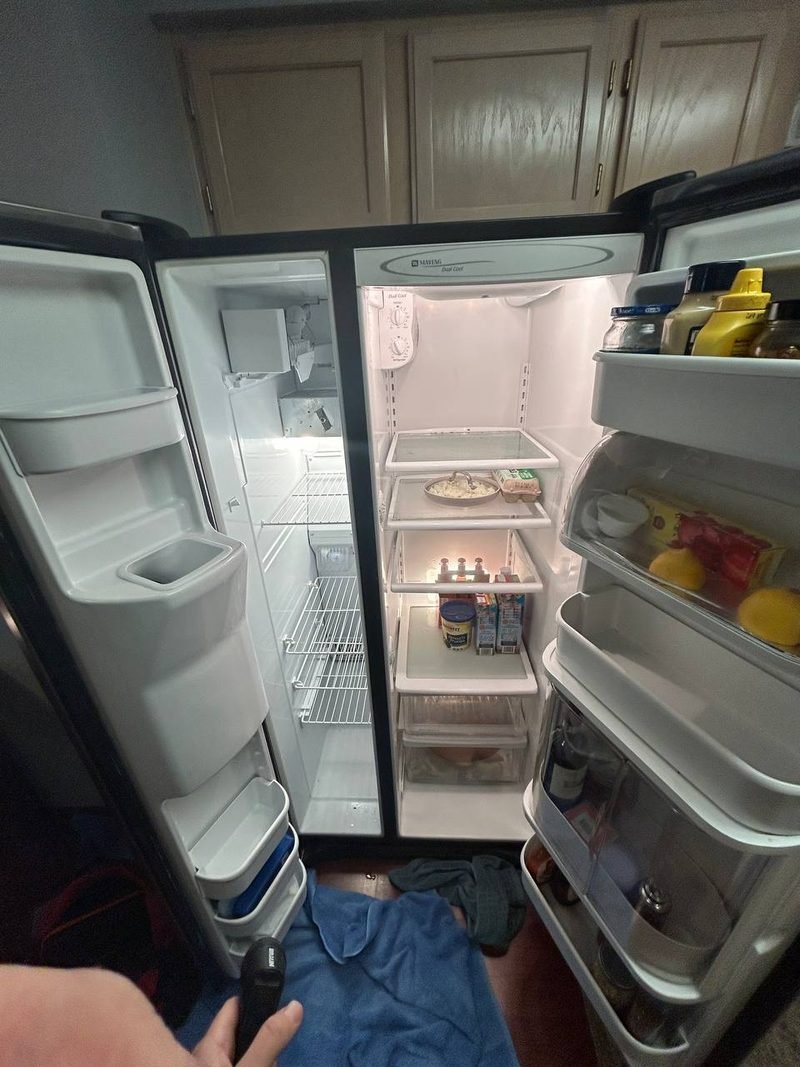
The layout changes by style, but the idea does not. On a top-freezer model, the duct and damper sit between the freezer floor and the fresh-food ceiling. On a side-by-side, the openings are in the wall that divides the two sides. On a French-door model with a bottom freezer drawer, cold air travels up a duct in the back wall to the fresh-food section. Some French-door models use a second evaporator and fan just for the fresh-food side, and the same reasoning applies to that coil.
The damper is either a manual baffle tied to the temperature dial or a small motorized door run by the control board. Either way, the fresh-food section has no cold source of its own. It gets what the freezer sends.
Why the freezer stays cold while the fridge warms
When the freezer is cold and the fresh-food side is warm, the system is still making cold, but the air is not getting through. The freezer sits right against the coil, so it can stay frozen on very little airflow. The fresh-food section depends on a steady stream through the duct, so it suffers first.
On our calls, the usual causes are a coil packed with frost, which blocks the air, and an evaporator fan that has stopped, which means no air moves at all. A stuck damper, a blocked vent and a struggling condenser are the next things we check.
Start with a real temperature reading
The dial number or display setting is not the actual temperature, and an air reading jumps every time the door opens. Put an appliance thermometer in a glass of water on the middle shelf of the fresh-food section and leave it for several hours or overnight. Water changes temperature slowly, so it shows what your food is actually sitting at. Read it quickly with the door barely open. Do the same in the freezer with a thermometer tucked between frozen packages.
The fresh-food section should hold 40°F or colder, and the freezer should be near 0°F. If the water reads well above 40°F while the freezer stays near 0°F, you have the problem this guide covers. If both sections are warm, the cause is more likely the condenser, the compressor or the sealed system, and you should call sooner.
Homeowner checks
- Check the controls. Make sure the fresh-food setting was not bumped warmer and that no vacation or energy-saving mode is on. Give any change a full day to show.
- Clear the vents. Find the cold-air outlet in the fresh-food section, usually high on the back wall or on the dividing wall, and the return openings, often lower down. Move anything pressed against them. An overpacked fridge blocks its own air: food near the outlet freezes while door shelves and crispers run warm. Leave room for air to move.
- Check the door gaskets. Look for tears, folds and flattened spots, especially at the bottom corners. Close the door on a strip of paper at several points; it should drag when you pull it out. A poor seal lets in warm, humid air, which warms the fresh-food side and feeds frost on the coil. Make sure bins and shelves are not holding a door open, and that the front sits slightly higher than the back so the doors swing shut.
- Listen for the evaporator fan. While the compressor is running, open the freezer and press the door switch with a finger. Most evaporator fans stop when the door opens and restart when the switch is pressed. You should hear the fan and feel air from the freezer vents. Silence, a squeal, or a ticking sound like a blade hitting ice are all clues.
- Look for frost. A light dusting of frost on food is normal. A white, snowy buildup on the freezer back panel or showing through the vent slots means the coil is likely iced over. Ice on the freezer floor points to a frozen drain.
- Clean the condenser coils. Unplug the refrigerator first. On many models, the coils sit behind the grille at the bottom front; on others, behind a lower panel at the back. Remove the front grille and vacuum the coils with a brush attachment or a coil brush. If you need to pull the fridge out to reach the back, go slowly so you do not kink the water line.
- Check the condenser fan. With the fridge plugged back in and the compressor running, you should feel warm air from the bottom grille or hear the fan at the back. Keep fingers away from the blade. A silent condenser fan while the compressor runs is a call for us.
Frozen evaporator coil: how defrost works and fails
Every time a door opens, humid room air gets in, and that moisture freezes onto the coil as frost. To keep the coil clear, the refrigerator regularly pauses cooling and runs a defrost cycle. When any part of that system fails, frost builds a little more each day until air can no longer pass through the coil. The freezer near the coil stays cold; the fresh-food side slowly warms.
Defrost heater
A heater, often a glass tube or a metal rod clipped to the coil, warms the coil just enough to melt the frost. The water drips into a trough, runs down a drain and evaporates in a pan near the compressor. Heaters burn out with age, and glass tubes can crack.
Defrost thermostat or sensor
A small thermostat clipped to the coil closes when the coil is cold so the heater can run, and opens once the coil warms to end defrost. Newer models use a temperature sensor read by the control. If the thermostat fails open, the heater never gets power. If a sensor reads wrong, the control may end defrost early and leave a little ice behind every time.
Defrost control
Older refrigerators use a mechanical defrost timer that advances while the compressor runs and switches power to the heater at intervals. Newer ones let the control board decide when to defrost based on run time and door openings. A timer stuck in the cooling position, or a board with a failed relay, never starts a defrost.
Frozen defrost drain
Sometimes the defrost works but the melt water cannot leave. The drain freezes or clogs, water pools in the trough and refreezes into a block at the bottom of the coil. Ice on the freezer floor, or water under the crisper drawers on some models, is the sign.
Evaporator fan and damper failures
The evaporator fan keeps cold air moving through both sections whenever the compressor runs. Fan motors wear out, and a blade can freeze into ice building on the coil or the back panel. Before a fan stops, it often squeals, chirps or ticks. With the fan dead, the coil gets very cold, the freezer stays fairly cold right next to it, and the fresh-food side warms over the next day or so.
A damper stuck closed gives the same symptom with a working fan. Motorized dampers fail electrically or freeze shut with frost, and manual baffles can stick. A fresh-food section running warm while the freezer runs colder than usual is a typical damper pattern.
Condenser coils and fan: dusty summers and garage fridges
The condenser is where the refrigerator gets rid of the heat it pulls out of the food. A fan pulls room air across the condenser coils and over the compressor. When the coils are matted with dust or pet hair, or the fan stops, heat cannot leave fast enough. The compressor runs longer, the coil does not get as cold, and the fresh-food side falls behind first.
Spokane's hot, dry summers, with wildfire smoke some years, mean more heat for the condenser to shed and more dust in the air. Refrigerators in garages have it hardest: summer heat in a closed garage, plus dust, leaves and lint. A garage fridge whose fresh-food side runs warm in late summer is often a condenser problem first. Garage refrigerators can also act up in winter cold snaps, but that usually shows as a soft freezer rather than a warm fridge.
Manual defrost: a temporary fix that proves the diagnosis
If you see heavy frost on the freezer back panel, a manual defrost can get you cooling again while you arrange a repair, and the result tells us a lot.
- Move food to coolers with ice or to another freezer.
- Unplug the refrigerator, or switch it off at its controls if your owner's manual describes an off setting.
- Leave both doors open, with towels on the floor and a shallow pan under the freezer if you can.
- Let the ice melt on its own. A heavily iced coil can take most of a day. A bowl of warm water in the freezer, swapped as it cools, speeds things up. Do not chip at the ice or use a heat gun.
- Dry the inside, plug it back in, set normal temperatures and let it cool for several hours before you reload the food.
Then watch it. If the fresh-food section cools normally and then warms again over the next several days as frost builds back, the defrost system has failed: the heater, the defrost thermostat or sensor, or the defrost control. The defrost bought you time and confirmed the diagnosis. If the fridge never cools properly even after a full defrost, the evaporator fan, the damper or the sealed system is more likely.
Food safety while you sort it out
Once the fresh-food section rises above 40°F, perishable food spoils faster, and the longer it stays warm the riskier it gets. Since the freezer is still cold, use it: move milk, meat, fish, leftovers and cooked dishes into the freezer or a cooler with ice as soon as you see a warm reading. Throw out perishables that have been warm for hours or that you cannot vouch for. Smell is not a reliable test, so when in doubt, throw it out.
What to tell the office when you call
- Brand and model number, usually on a label on a side wall inside the fresh-food section or under the crisper drawers.
- Style: top-freezer, side-by-side, French-door or built-in, and whether it has an ice maker or water dispenser.
- Your thermometer readings in both sections, and when the fresh-food side started running warm.
- What you saw and heard: frost on the freezer back wall, a quiet or noisy fan, water or ice on the floor.
- What happened after a manual defrost, if you did one, and how long the cooling lasted.
- Where it sits: kitchen or garage, and whether it was moved or lost power recently.
If cost comes up, the office names the diagnostic fee when you call, and the technician writes one price before any work starts.
When to call us
Call us if the fresh-food section stays above 40°F after the vents, gaskets and condenser coils check out, if you see frost on the freezer back panel, if the evaporator fan is silent or noisy, or if a manual defrost helps for only a few days. Call sooner if both sections are warm, if the compressor clicks on and off without running, or if a full freezer is at risk. A frosted coil can also slow ice production, so mention it if your ice maker has slowed down; our ice maker repair page covers that side.
Our refrigerator repair technicians test the defrost heater, defrost thermostat or sensor, defrost control, fans and damper rather than guessing, and work on French-door, side-by-side, top-freezer and built-in models across Spokane and nearby towns. We answer calls every day; call and the office tells you whether a technician can reach your address today. You can contact us online, or call or text (509) 370-5361.

Page reviewed by Adam, Larch technician
Technician · heating, cooling and appliances · Updated October 2026
Adam works on furnaces, heat pumps, AC and household appliances on our Spokane-area calls. He tests first, shows you the failed part and writes the price before any repair.